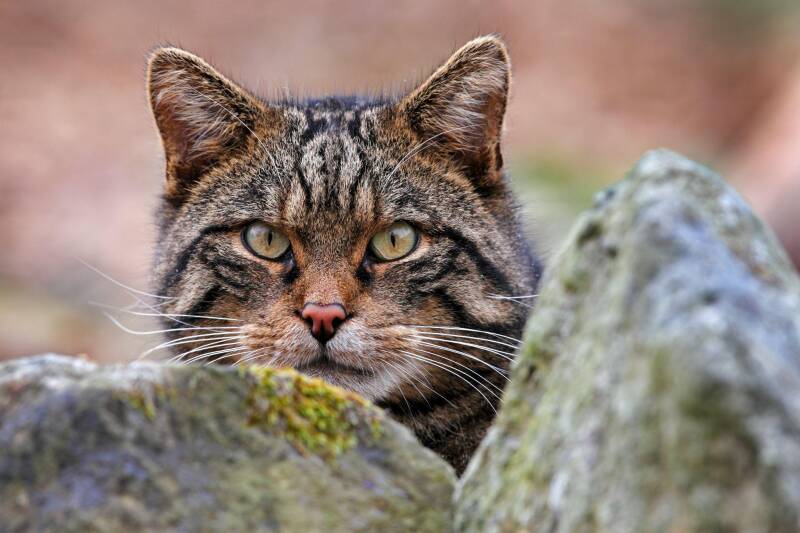
Saving the Scottish Wildcat
by Annette J Beveridge
Only seven years ago, in 2019, conservationists declared the Scottish wildcat as functionally extinct, but now they are working to prevent this from happening again and a 20-year strategy has been designed to secure their future.
More than 25 organisations and individuals have worked together to create the strategy to restore the species to sustainable levels. The strategy was launched at the Eurowildcat Conference at the Highland Wildlife Park in Kingussie, Scotland.
Scottish wildcats feed primarily on rabbits, but also on mice and voles. They will turn their attention to birds, insects, reptiles and amphibians, and even eat grass or bracken if necessary. They live in mixed woodlands but are also found in scrub and moorland.
Sexually dimorphic, male wildcats are larger and longer than females. They can weigh up to 5kg and measure around 59 cm excluding the tail, which can measure 26- 33 cm. Females weigh approximately 4 kg.
Wildcats have a stockier build than domestic cats. They have longer legs and a larger head. The tail is distinct, black-tipped and bushy with black rings. Stripes run down the fur on the body.
Threats
One of the biggest threats facing Scotland’s wildcats may be surprising. - other cats. If wildcats mate with domesticated or feral cats, it can dilute their genetic characteristics and threaten the species' survival. But there are other dangers. This includes wildcats dying on roads, fragmentation of suitable habitat, and feline diseases.
Solutions
Wildcats need to be able to roam, and this is a key part of the plan, but this means restoring and reconnecting habitats. There is also a call for responsible ownership of domestic cats, including vaccination, neutering and microchipping. Conservationists are keen to work alongside people who live in potential release areas.
Saving Wildcats partnership has already successfully released captive-bred wildcats into the Cairngorms National Park. The first of which happened in 2023, and wild-born kittens were recorded in 2024. This has given conservationists vital information on what is needed.
The future
The Scottish Wildcat (subpopulation) used to range across the British mainland, but historic persecution, hybridisation and habitat loss led to as few as 115 individuals remaining in the wild. Now, as part of conservation efforts, fifty wildcats have been released into the Scottish Highlands. With careful habitat restoration and careful conservation releases, there is hope that the Scottish wildcat can once again thrive across Scotland.