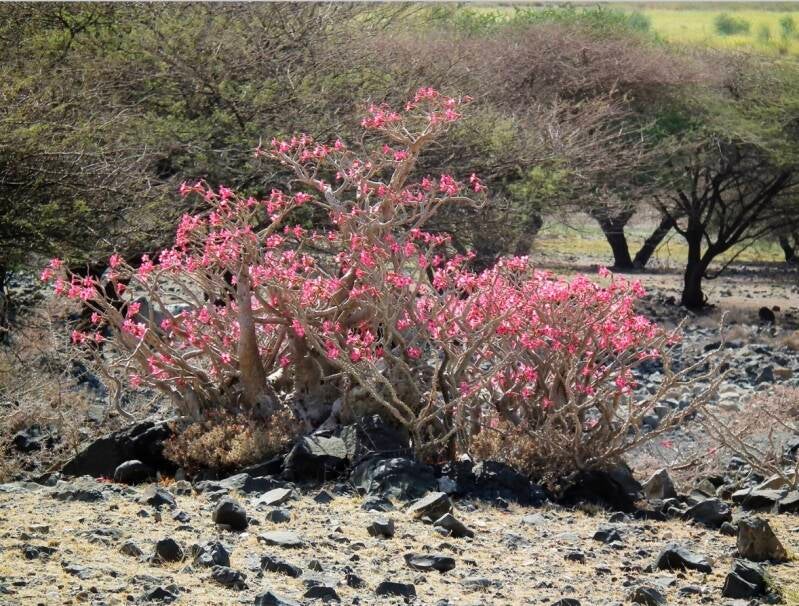
A mature desert rose looks as if it belongs to another world with its large, swollen, bottle-shaped trunk. The plant pictured e is yet to develop its hefty trunk, but with its stunning pink-and-white flowers, it adds beauty and colour to the starkness of the area. But behind the beauty, there lies a deadly defence. Adenium Obesum, (Desert Rose or Bottle Tree) contains a milky white sap with toxic glycosides, strong enough to blur vision, cause vomiting, and alter the heart's rhythm if too much is consumed. It can be deadly.
Belonging to the dogbane family, Apocynaceae, it is native to eastern Africa and the Arabian Peninsula and is perfectly adapted to dry environments. The plant may draw the eye with its beautiful flowers and thick bulbous base called a caudex, but it has an amazing drought-survival strategy.
It may look delicate, but it is incredibly tough and can thrive in landscapes which can seem too harsh for life. That bulbous trunk contains a resource that is so precious - water.
There are four main components for survival. In some species of desert rose, the caudex can reach up to 2.4m in diameter, storing large volumes of water. The plant will also shed its leaves as a water-saving mechanism if needed, and if water is scarce, it stops growing and halts the flowering process. Think of this as a physiological slowdown.
It has an opportunistic root system. This is where the roots spread widely to capture rainfall. Water is then absorbed quickly and stored in the caudex.
Despite its defences, there are pests that can damage flowers and drink the sap, including aphids, mealybugs, and spider mites. Scale insects attach to the stems and the caudex, and ants, attracted to the honeydew from aphids and mealybugs, will actively 'farm' them.