Coral Reefs: The Healing Power of Touch
We have long known that a simple touch from a loved one can make a dramatic difference, calming us and helping us to feel better. But who knew that a simple touch from one coral to another could actually heal?
In what can only be called an astonishing discovery during a laboratory experiment, scientists realised that even the most severely bleached corals, close to dying, could recover fully if placed by, and in touch with, healthy, genetically identical coral.
With warming oceans and coral reefs under stress, this discovery comes at a critical time.
Marine heat waves, due to climate change, are putting vital ecosystems at risk. Projections suggest coral reefs could disappear from many areas within a few decades if warming continues.
People often think of corals as underwater plants or rocks, but they are animals
Corals depend on microscopic algae which live inside their tissues and provide food through photosynthesis, which helps corals grow and survive. If ocean temperatures become too warm, corals lose these beneficial algae. This process is known as coral bleaching, where they look white, as the supply of energy gradually reduces.
Corals become weaker and more vulnerable to harmful organisms. If this continues, they are likely to die. Even if bleached corals manage to survive, it can take months or even years for their health to return. Danny Collins, lead author studying oceans at Stanford University's Doerr School of Sustainability, commented that 'although bleached corals may be dying, they are not dead yet.'
An unexpected discovery
Co-author of the study, Steve Pelombi, a professor of marine sciences at Stanford, noticed that two fragments from the same coral colony had fallen against each other in the aquarium setting. One fragment was healthy, but the other had bleached. The bleached coral began to regain some of its colours. This raised a question of whether healthy corals could help damaged corals simply by being next to them. Collins considered how disease spread, and whether investigating bacteria carried by plastic debris could be used to introduce something more beneficial instead.
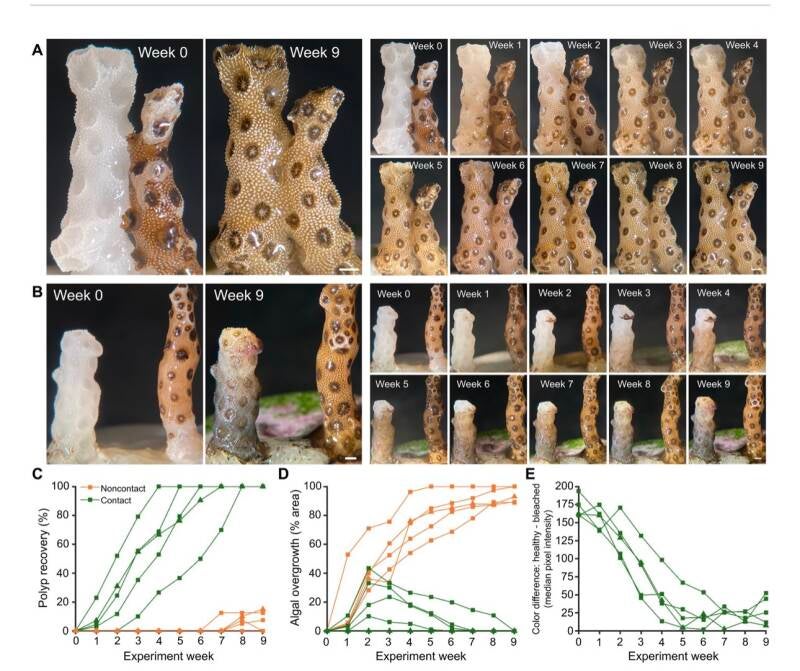
The researchers designed an experiment involving ten pairs of coral fragments. Each pair contained one healthy fragment and one bleached fragment taken from the same coral animal, so they were genetically identical. The results were significant.
All of the bleached fragments kept apart from healthy corals died, while those touching healthy corals recovered within seven weeks.
Researchers discovered that genetically identical corals recognise each other and the tissues fuse together. Once the tissues align, tiny channels create connections whereby material passes through. This allows beneficial algae and nutrients to move from the healthy coral to the bleached one. In just three days, researchers could see the change. Even after the algae were separated, healing continued. During the second week of contact, algae fragments doubled every four days. This was 10 x faster than had been observed in wild corals.
The technique cannot yet be used across entire reefs, as each bleached coral would need access to a healthy coral with the same genetic identity.
One possible solution to combat the negative impacts of warming oceans and bleaching is to collect beneficial algae from healthy corals before marine heatwaves occur. These could be stored and introduced into damaged corals afterwards to help boost recovery.
Research published in Science Advances